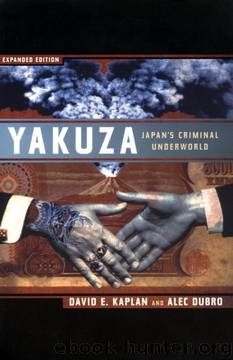
Yakuza: Japan's Criminal Underworld by David E. Kaplan
Author:David E. Kaplan [Kaplan, David E.]
Language: eng
Format: epub, mobi
Tags: Biographies & Memoirs, True Crime, History, Asia, Japan, Politics & Social Sciences, Politics & Government, International & World Politics, Asian, Social Sciences, Specific Demographics, Asian American Studies, Sociology, Political Science
ISBN: 0520215621
Amazon: B0028QH1B0
Publisher: University of California Press
Published: 2003-02-01T11:00:00+00:00
Those who decided to pull away from the gangs found the yakuza were like flypaper-very sticky. The gangsters are extremely skilled at exploiting the web of debt and obligation that binds so much of Japanese society together, observes Raisuke Miyawaki, the former top yakuza watcher for the NPA. "Members of the business world and the underworld became involved in each others' deals and indebted to each other," he says of the Bubble days. "Once gangsters became immersed into the financial system, they were very hard to disengage." Leaned on by their yakuza contacts, corporations soon found themselves hiring employees tied to the gangs and lending more and more money to mob-run enterprises.
The gangs, meanwhile, were joined in the feeding frenzy by other, sometimes less sophisticated, crooks. Some were independents-embezzlers out to make a quick killing, fraud artists searching for the right angle-but most seemed tied to yakuza crime syndicates in some way. Indeed, the Bubble strung together perhaps as never before the disparate parts of the Japanese underworld: yakuza, rightists, sokaiya, and other gangs of thugs and extortionists. These keizai yakuza could be seen in the lobbies of firstclass hotels in Tokyo practicing what was soon dubbed "lobby diplomacy." Amid drinks of tea and whiskey, they exchanged tips on interest rates, ripe targets for extortion, and the hottest property developments. The hotels and police seemed powerless to do anything about the gatherings.
Buoyed by their seeming acceptance by the business world, the yakuza sensed a change in their social status. "The gangs no longer felt inferior," says Miyawaki. "Once they saw the crooked activities of supposedly legitimate businessmen and bankers during the Bubble Era, the yakuza began to discard their traditional sense of guilt." Others in the business community sadly agree. "It used to be that the yakuza economy and the legitimate economy were separate," bemoaned one Mitsubishi Bank executive. "Now they have come together."
The risks of that coming together would become apparent soon enough. In 1988, the investment community was shaken by the disappearance of Kazuo Kengaku, a bright Japanese fund manager known for his ties to the Yamaguchi-gumi. Kengaku and his Cosmo Research had made fast profits for their clientele by ramping stocks and greenmailing companies, but losses mounted after the market crash of October 1987. A year after the crash, Kengaku was finally found, buried in concrete and dumped in a field near Kyoto. Police suspect Kengaku's fate was tied to his investors' poor stock performance.
Download
Yakuza: Japan's Criminal Underworld by David E. Kaplan.mobi
This site does not store any files on its server. We only index and link to content provided by other sites. Please contact the content providers to delete copyright contents if any and email us, we'll remove relevant links or contents immediately.
Mindhunter: Inside the FBI's Elite Serial Crime Unit by John E. Douglas & Mark Olshaker(9339)
Wiseguy by Nicholas Pileggi(5783)
Room 212 by Kate Stewart(5119)
Hitman by Howie Carr(5094)
Secrecy World by Jake Bernstein(4752)
Killers of the Flower Moon: The Osage Murders and the Birth of the FBI by David Grann(4447)
Papillon (English) by Henri Charrière(4274)
Breaking Free by Rachel Jeffs(4217)
Killers of the Flower Moon by David Grann(4055)
Say Nothing by Patrick Radden Keefe(3984)
American Kingpin by Nick Bilton(3886)
The Secret Barrister by The Secret Barrister(3708)
Molly's Game: From Hollywood's Elite to Wall Street's Billionaire Boys Club, My High-Stakes Adventure in the World of Underground Poker by Molly Bloom(3536)
Mysteries by Colin Wilson(3454)
In Cold Blood by Truman Capote(3384)
Signature in the Cell: DNA and the Evidence for Intelligent Design by Stephen C. Meyer(3138)
I'll Be Gone in the Dark by Michelle McNamara(3082)
Rogue Trader by Leeson Nick(3043)
Bunk by Kevin Young(2997)
